Trigger Point Dry Needling
A targeted physical therapy technique to help relax tight muscles, reduce pain, and improve movement and function.
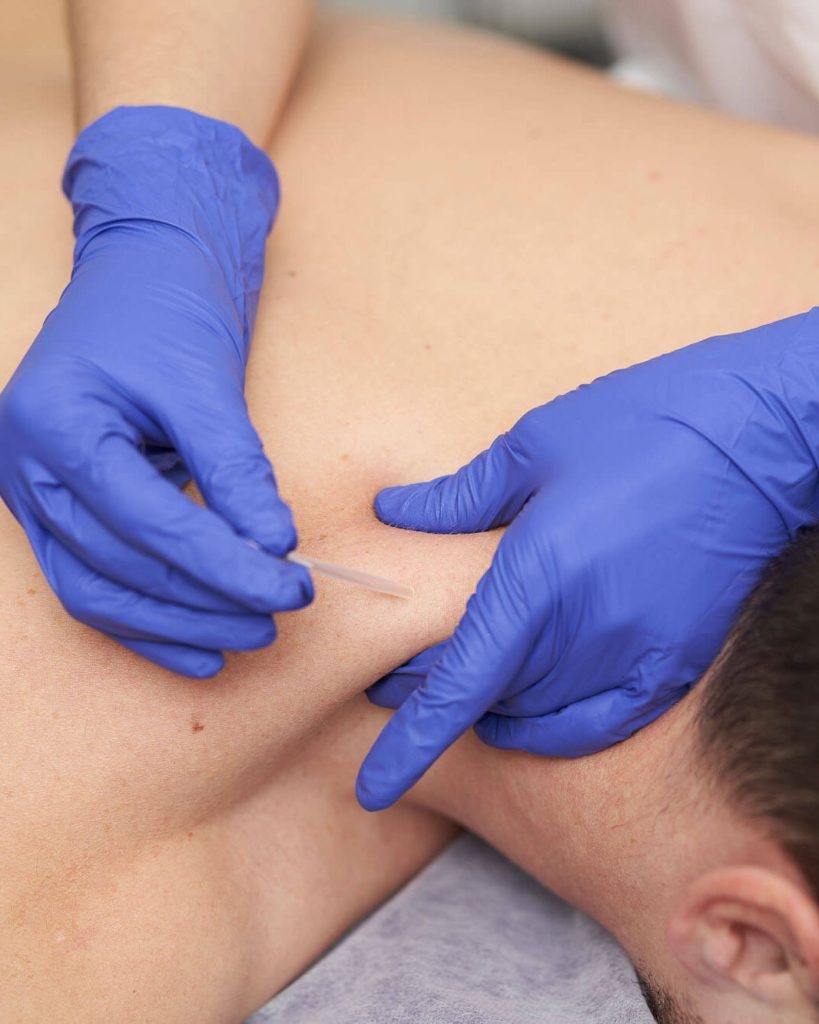
What Is Trigger Point Dry Needling?
Our licensed physical therapists are trained and certified in safe dry needling techniques.
Dry needling, also known as intramuscular stimulation, uses very small-diameter solid filament needles carefully inserted into trigger-point areas of painful muscles and connective-tissue fascia. It is a hands-on physical therapy technique used as an adjunct to manual treatment—not a replacement for it.
Trigger points are taut, tender bands within muscles and surrounding fascia. They can cause local pain or refer pain to more distant locations, restrict pain-free mobility, and limit muscle function and smooth, coordinated movement.
Dry needling is different from acupuncture. While both use a small solid filament needle, acupuncture is part of a different Eastern medicine discipline. Dry needling is based on functional anatomy, soft-tissue mobilization, myofascial release, and trigger-point therapy.
1
Find the source
Your PT evaluates posture, movement, joints, muscles, and fascia. Using skilled hands-on assessment, they identify restrictions, knots, and tender trigger points that may be contributing to pain or inefficient movement.
2
Target the taut band
Stimulation of a trigger point may cause a brief twitch response—a small, quick muscle contraction. This is associated with softening of the taut band and an immediate decrease in trigger-point sensitivity.
3
Restore movement
After needling, your therapist continues with manual tissue mobilization, stretching, movement training, strengthening, and individualized exercises to help you carry the improvement into daily life, work, and sport.
Conditions Dry Needling May Help
Any pain of orthopedic or musculoskeletal origin may benefit from dry needling as part of a complete physical therapy plan. Surrounding muscles can develop trigger points that contribute to pain and movement inefficiency.
Head, Neck & Spine
Back and neck pain, headaches, TMJ dysfunction, pinched nerves, herniated discs, sciatica, sacroiliac dysfunction, and pain with tingling or numbness.
Shoulder, Arm & Hand
Rotator cuff tendinitis and tears, shoulder impingement, frozen shoulder, tennis elbow, golfer’s elbow, carpal tunnel syndrome, and general arm pain.
Hip, Leg & Foot
Acute or chronic muscle strains, knee or shin pain in runners and athletes, Achilles tendinitis, plantar fasciitis, and other lower-extremity pain.
More Than Temporary Relief
At Body Mechanics, dry needling is integrated with personalized, one-on-one care. Your PT first looks at the whole picture: your history, posture, work or sport demands, functional movement, joint mobility, and soft-tissue restrictions.
For example, trigger points in the head and neck can contribute to headaches, dizziness, ringing in the ears, limited neck or jaw mobility, and poor muscle stabilization. Direct trauma, uneven pressure, repeated muscle overload, and postural stresses can all contribute. Treating the trigger point while also improving alignment, movement habits, and strength can help break the pain cycle.
We combine targeted needling with manual soft-tissue and joint mobilization, myofascial release, posture and movement training, and home exercises so you can become an active participant in your recovery.
Experienced, Individualized Care
Body Mechanics has provided personalized, whole-body physical therapy since 1996. You meet one-on-one with the same therapist during a 30–60 minute session, with focused attention to help achieve better results in fewer appointments.
Training & Certification
Dry needling falls within the scope of practice of Wisconsin licensed physical therapists who have completed organized training. Body Mechanics therapists use dry needling as a precise extension of skilled manual physical therapy.
Available at Both Clinics
Our treatment techniques are available at Body Mechanics clinic locations in Downtown Milwaukee and Pewaukee. We work to pair you with the physical therapist best suited to your needs and goals.